

Nicolaus Copernicus heliocentric proposition
When it comes to doing open, fair minded and impartial science, we should all be careful of falling into the dogma trap, where our worldview undermines our interpretation of the data at hand. Consider the following examples of bad science from both sides of the theistic divide, namely theism and materialism.
Bible fundamentalism
In 1543 Nicolaus Copernicus published his famous work “On the Revolutions of the Celestial Orbs”. In it, he proposed that the earth and planets orbited the sun. This flew in the face of the centuries old, and then current view, that held that the earth was fixed in the center of the universe and that the sun, stars and planets revolved around it. In fact Aristotle had proposed that view in the 4th century BC already. Almost 100 years later in 1632, Galileo also proposed the same idea in his work titled “Dialogue concerning the Two Chief World Systems”. He was attacked by Aristotelian philosophers as well as the Roman Catholic Church for his ‘moving earth’ theory. This is perhaps the greatest iconic incident in which the church was seen as antagonistic to science. After all, there were many verses in the bible that ‘taught’ that the earth was fixed and did not move. Example verses: Psalm 104v5, 1 Chronicles 16v30 and Psalm 93v1. Moreover, Joshua had bid the sun to stand still in Joshua 10v12, indicating that it was the sun that moved as opposed to the earth. Back then, it was a consensus that Copernicus and Galileo were up against. Nowadays, no one would refute the notion that the earth revolves about the sun nor that the text is written in phenomenological terms. Indeed, the sun doesn’t actually rise nor does it actually set, it is merely the earth turning about its axis.
The error the church had made was simple; the church thought that the bible was a book that also gave them their answers to science, and as such the facts once investigated would undoubtedly show that the bible did indeed have the answers all along. In 1992 Pope John Paul II officially declared that Galileo was right. The formal rehabilitation was based on the findings of a committee of the Academy the Pope set up in 1979, soon after taking office. The committee decided the Inquisition had acted in good faith, but was wrong.
Another example of this in modern day church is that of some holders of Young Earth Creationism, where the claim is that because the bible talks about the 7 days of creation, it must be that the earth was in fact created in 7 literal days! (although this could just be down to interpretation of scripture, for a great investigation of this topic I highly recommend the book ‘Seven days that divide the world’ by John Lennox.) Again, bible and ‘facts’ first, investigation later.
Materialism

Galileo before Holy office
But what about materialism? Materialism (in this post) is the belief that all of reality is material, that no spiritual entities, such as the soul or God, exist. It surely doesn’t fall into the same error category, does it? After all, science is where all truth is discovered according to materialism, right?
Well, yeah, materialists are indeed supposed to have a science-strictly driven approach to truth. But consider this comment from famous evolutionary biologist and geneticist Richard Lewontin of Harvard University: “… Our willingness to accept scientific claims that are against common sense is the key to an understanding of the real struggle between science and the supernatural. We take the side of science in spite of the patent absurdity of some of its constructs, in spite of its failure to fulfil many of its extravagant promises of health and life, in spite of the tolerance of the scientific community for unsubstantiated just-so stories, because we have a prior commitment, a commitment to materialism. It is not that the methods and institutions of science somehow compel us to accept a material explanation of the phenomenal world, but, on the contrary, that we are forced by our a priori adherence to material causes to create an apparatus of investigation and a set of concepts that produce material explanations, no matter how counter-intuitive, no matter how mystifying to the uninitiated. Moreover, that materialism is absolute, for we cannot allow a Divine Foot in the door.”1
Well now, if the bible fundamentalists have an a priori commitment to scientific truths about the world from the bible before investigation, and the materialists have an a priori commitment to materialism being the answer before investigation, then they too must be fundamentalists, but from the opposite direction. Both have the answer before investigating the facts, both go to the facts because they want to illustrate what they already know to be true! That of course is not the scientific method but dogma. Both are, in fact, question begging in favor of their world views (one of them is right though!). Conceptually, the two fundamentalists are at opposite ends of the spectrum, theism on the one side, and atheism on the other.
Is there a similar example of where materialism can be seen to be antagonistic to science as we saw was the case regarding the Roman Catholic Church and the heliocentric model earlier? The short answer is yes. One such example is in that of complex specified information (CSI). If you gave a materialist a book, say a Shakespeare book, which contained highly CSI, and then asked the materialist to reduce the book into its material constituents i.e. the paper and the ink, would the materialist be able to, from the paper and the ink, give the content of the book that it once was? Of course not, its just paper and ink now. You could know all there is to know about the chemical laws governing the combining of the paper and the ink and you would know nothing about the content of the plays of Shakespeare that were in the book. That’s because the paper was merely a medium which contained the CSI, but while that medium is physical it could also change without the CSI on it changing. To see this, consider the same book in the form of an audiobook. Now the medium is sound waves and yet the CSI content stays the same. The book could have been turned into a movie too. Or the CSI could have been stored on a silicon disk, or on a CD, or in a biological cell (DNA) etc… (in fact, regarding DNA, Francis Crick, co-discoverer of the structure of DNA, once wrote that biologists must constantly remind themselves that what they see was not designed but evolved! Back to CSI.) I think I have made it pretty clear that the CSI content is not contingent on the medium it is being stored upon, and if CSI is not energy or matter, then what is it? Quite simple: CSI is immaterial. And as per scientific observation , CSI only originates in a mind. And so this is an example of where materialism breaks down. They have no answer to this. So when an open-minded, impartial person asks “Well where does information come from?” we do not get any satisfactory answer from the materialist. (for a great book on this topic read Bill Dembski’s The Design Inference)
At this point you might ask how this option of materialism arose?
If there ever was one theory that gave birth to materialism on a broad scale, it would have to be the theory of evolution from Charles Darwin in the 19th century. In particular the thesis of natural selection on random variation (nowadays the reference changes to random mutation thanks to our better microscopes). Now, for a materialist to have a complete picture of reality they need answers in all spheres of it, so even if the answers are bad that’s fine with them because a bad answer is at least better than no answer. Was the aforementioned thesis a bad answer? Well not if you think that the extrapolation of small scale changes occurring within a species to being the same mechanism responsible for whole new body plans and species is a good idea! But that is exactly what drove the removal of God from the equation in the 19th century, the grand extrapolation that the mechanism responsible for changes in the small was the same mechanism responsible for changes in the large (some may know this as micro- vs macro-evolution). Of course the grand extrapolation on nothing more than gross anatomy was clung on to for dear life, purportedly to have been arrived at by fair, open minded and impartial investigation. Today the weak theory is still held by many ardent ‘believers’, even though we have now progressed from gross anatomy to microbiology and biochemistry and encountered numerous mathematical challenges to the thesis of natural selection on random mutation. In fact nowhere has it been observed nor demonstrated that the mechanism of natural selection on random mutation can indeed build whole new body plans. But, because it is the only theory out there that has a natural ontology to it, it remains the standard (‘uncontested’) theory in atheistic academia.
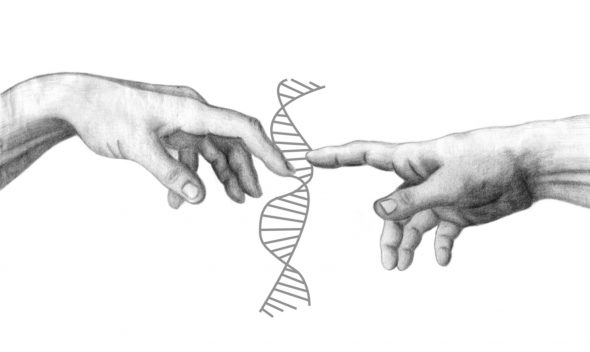
Science, when done in an open minded and impartial fashion, is open to both material and immaterial explanatory hypotheses being responsible for various aspects of reality. Case in point is that of the origin of biological information (commonly referred to as DNA). If we observe daily that the only origin of information is a mind, then why should we not posit a mind as being possibly responsible for the origin of biological information? That is of course the hypothesis of Intelligent Design Theory. If at any point we find that we are not allowing an explanatory hypothesis in the door on account of a difference in worldview, then we have done away with fair, open minded investigation, and so too with progress.
______________________________________________________________________________________________________________________________________
- Lewontin, Richard (1997), “Billions and Billions of Demons,” The New York Review, January 9.




Leave a comment